Physics is all around us — from why an apple falls from a tree to how your phone works, why the sky is blue, or how rockets launch to space. But what exactly is physics? Let's understand it simply and completely.
What is Physics? (Simple Definition)
Physics is the fundamental natural science that studies matter, energy, motion, forces, space, and time — and how they interact in the universe.
- It explains the basic laws governing everything: from tiny particles (like electrons) to huge galaxies.
- The word "physics" comes from Greek "physikos" meaning "natural" or "nature."
- Goal: Discover simple, unified laws (using math) that explain all natural phenomena.
In short: Physics is the study of how the universe works at its most basic level.

(Image: Infographic explaining "What is Physics?" with core branches, everyday life examples, and future scope. Direct URL: https://i.ytimg.com/vi/AUDRN-2GYZs/maxresdefault.jpg)
Main Factors / Fundamental Concepts in Physics
These are the key "factors" or building blocks physics studies:
- Matter — Anything with mass and volume (solids, liquids, gases, plasma).
- Energy — Ability to do work (kinetic, potential, heat, electrical, etc.).
- Motion — Change in position over time (speed, velocity, acceleration).
- Force — Push or pull that changes motion (gravity, friction, etc.).
- Space & Time — The framework where everything happens (spacetime in relativity).
- Fundamental Forces — The 4 basic interactions (see below).
These explain everything from daily life to black holes.
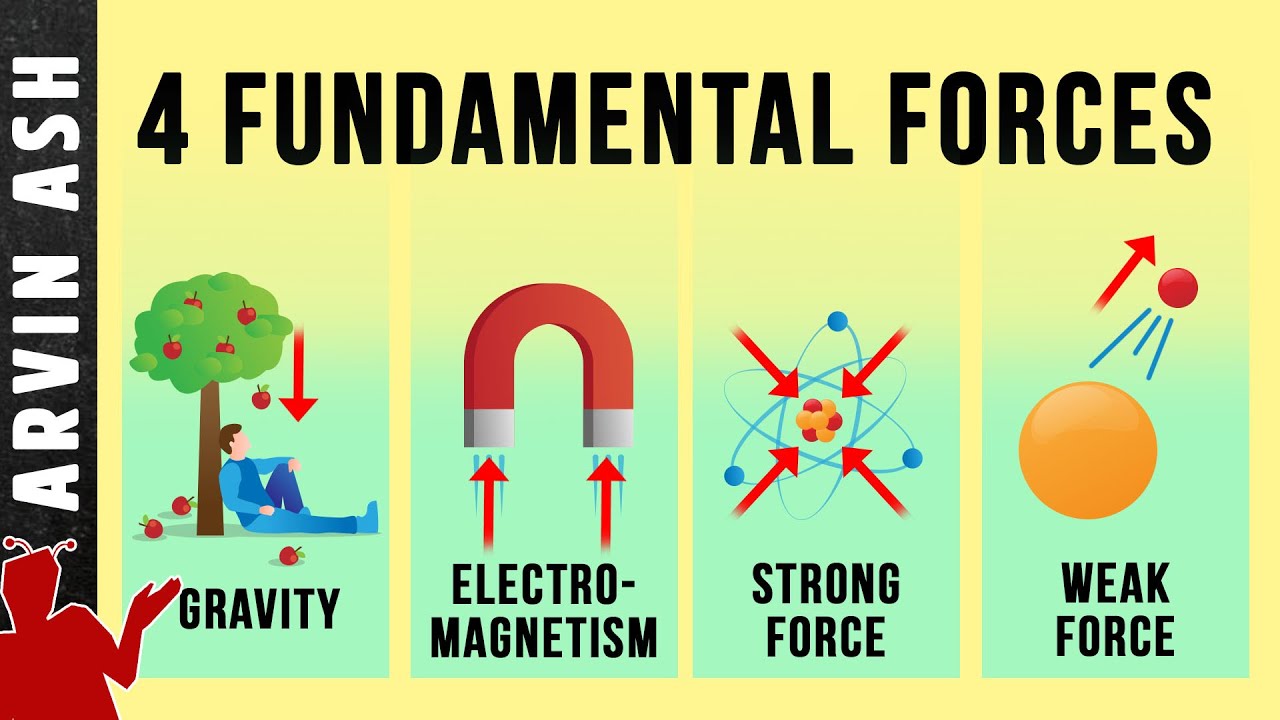
(Image: Illustration of the 4 Fundamental Forces of Nature: Gravity, Electromagnetism, Strong Nuclear, Weak Nuclear. Direct URL: https://i.ytimg.com/vi/669QUJrF4u0/maxresdefault.jpg)
The 4 Fundamental Forces (Key Factors of Interactions)
Physics reduces all forces to these 4:
- Gravity — Weakest but long-range; pulls masses together (e.g., Earth keeps us down).
- Electromagnetism — Acts on charged particles; responsible for electricity, magnetism, light.
- Strong Nuclear Force — Binds quarks in protons/neutrons and holds nucleus together.
- Weak Nuclear Force — Causes radioactive decay and nuclear reactions in stars.
These forces govern all interactions in the universe.
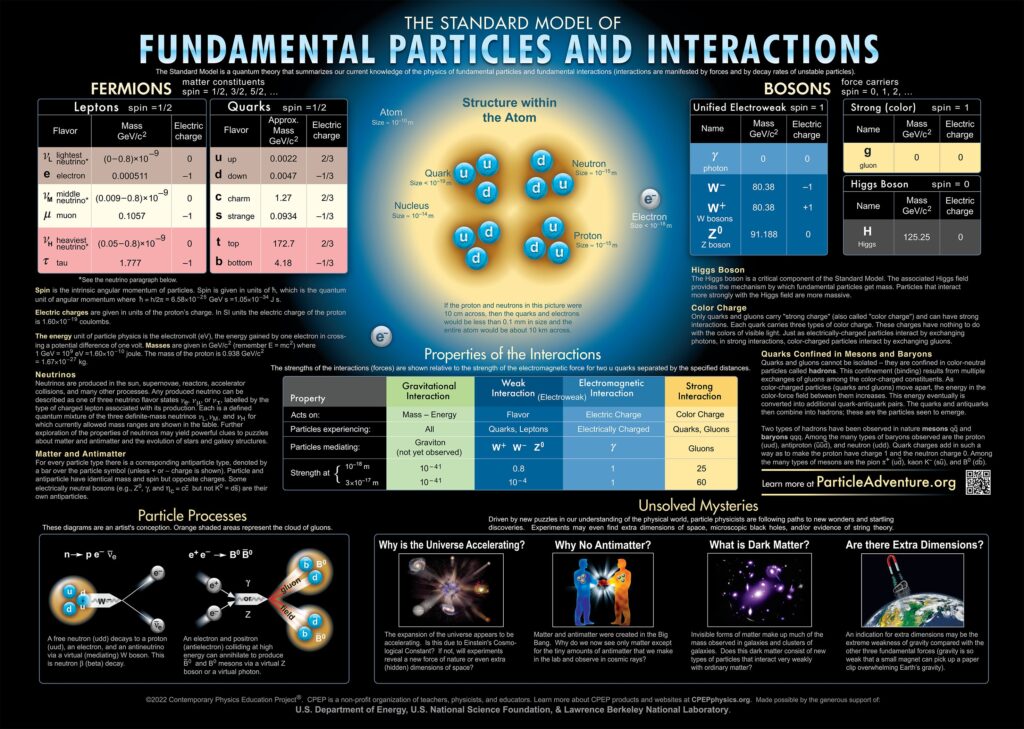
(Image: Standard Model chart of fundamental particles and forces — shows quarks, leptons, bosons. Direct URL: https://www.cpepphysics.org/wp-content/uploads/2022/06/particle_chart_May.5.2022-29.5-21-print1-1024x729.jpg)
Main Branches of Physics
Physics is divided into many branches:
Classical Physics (everyday scale):
- Mechanics (motion, forces)
- Thermodynamics (heat, energy)
- Electromagnetism (electricity, magnetism)
- Optics (light)
- Waves & Acoustics (sound)
Modern Physics (extreme scales):
- Relativity (high speeds, gravity — Einstein)
- Quantum Physics (tiny particles)
- Nuclear & Particle Physics
- Condensed Matter Physics (solids/liquids)
- Astrophysics & Cosmology (stars, universe)
Other applied branches: Biophysics, Geophysics, Medical Physics.
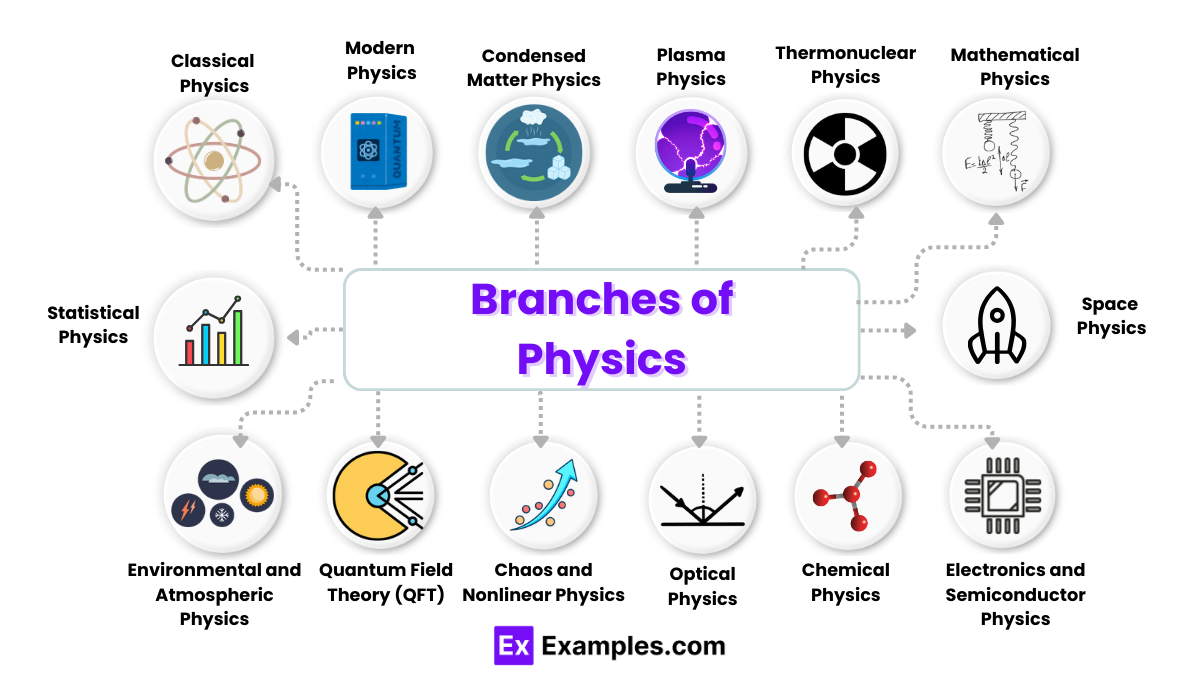
(Image: Flowchart of major branches of physics with examples. Direct URL: https://images.examples.com/wp-content/uploads/2025/01/Branches-of-Physics.png)
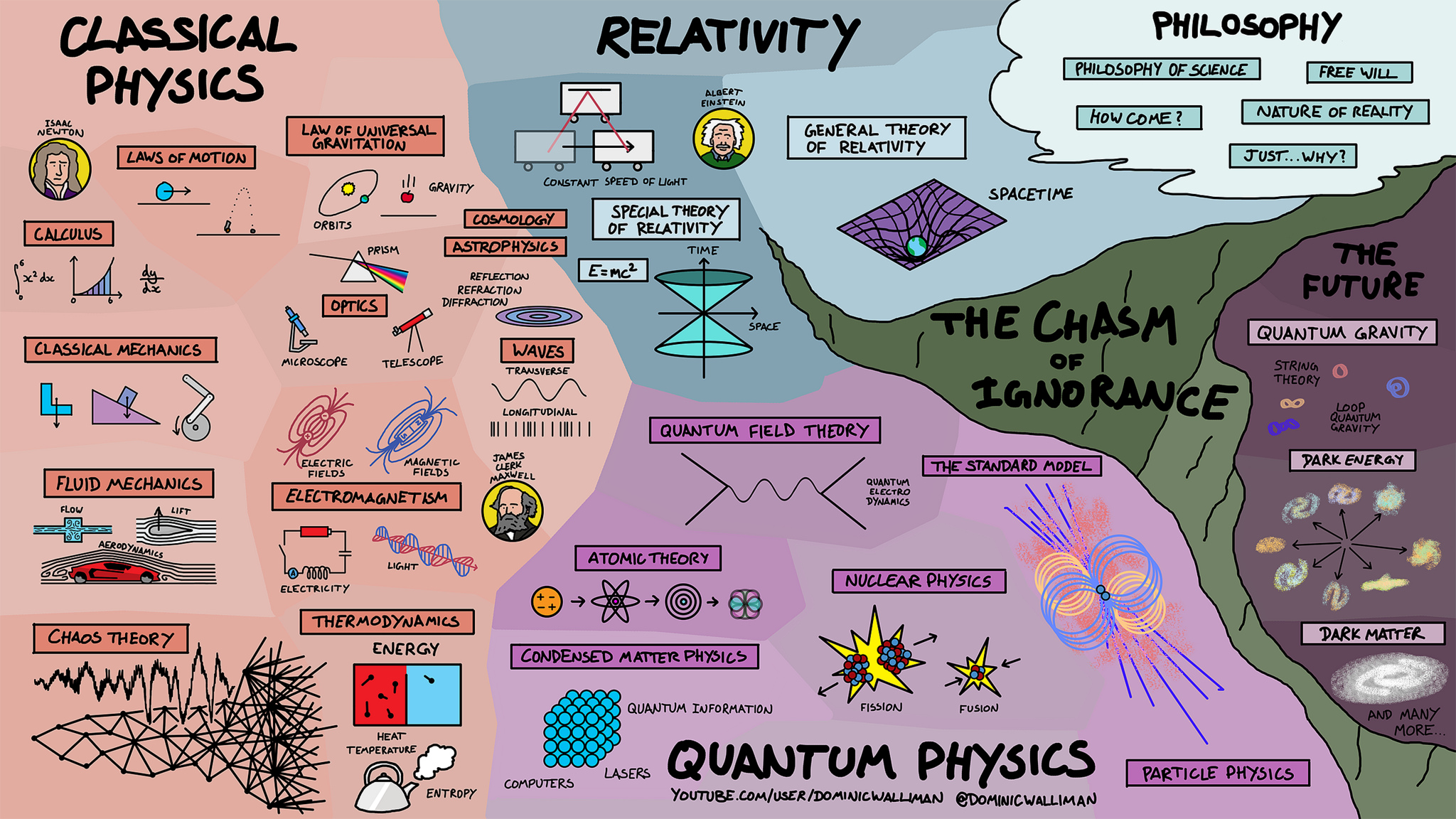
(Image: Big map of physics — from classical to quantum, relativity, and future mysteries. Direct URL: https://bigthink.com/wp-content/uploads/2017/12/origin-155.jpg)
Scope & Importance of Physics
- Scope: From subatomic particles to the entire universe (10^-15 m to 10^26 m).
- Importance: Basis for technology (phones, computers, MRI, solar panels, GPS), engineering, medicine, space travel.
- In India: Helps in ISRO rockets, nuclear power, renewable energy.
Physics drives innovation and solves real problems.
Real-Life Examples
- Gravity: Why things fall.
- Electromagnetism: Your fan runs on electricity.
- Quantum: How LEDs in screens glow.
- Nuclear: Power plants or sun's energy.
Conclusion
Physics is the foundation of all sciences — it answers "how" and "why" the world works. Start with basics like motion and forces, then explore quantum or relativity. It's exciting and useful for jobs in engineering, research, teaching.
Want more? Comment below — next post could be "What is Mechanics?" "Laws of Motion" or "What is Quantum Physics?"
(Keep comments enabled!)
Add labels: physics, what is physics, branches of physics, fundamental forces, matter energy, physics definition, beginner guide, JEE NEET physics.



0 Comments